

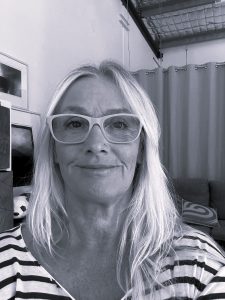
Sam Gowing is a multifaceted creative with a deep passion for the environment. With over three decades of experience across Melbourne, Sydney, and the Gold Coast, Sam’s work spans sculpture, design, teaching, and advocacy for sustainability.
After graduating from the College of Fine Arts (COFA) in Sydney, Sam exhibited paintings, sculptures, and installations that explored themes of identity and the fragility of self. Over the years, her artistic focus shifted outward, inspired by her love for the ocean and native wildlife, to address environmental issues and humanity’s connection with the natural world.
Her sculptural works capture the fragility and resilience of wildlife. She replicates natural forms and creatures, often at a different scale or in an incongruous colour, by using illumination to emphasise transparency and transformation, her pieces evolve throughout the day, radiating an ethereal glow that invites reflection on the delicate balance of nature.
What sparked the idea for the work you are exhibiting at SWELL this year?
The idea for Love and Survival – Bush stone-curlews began with an unexpected encounter in the carpark of my local shopping centre, Stocklands on the Gold Coast. Two of these prehistoric-looking birds were simply hanging around, and I was instantly intrigued. Each time I returned, I would look for them, often finding them resting or nesting in prime, traffic-heavy spots. On one visit, I saw a bright fluoro safety fence around them, with a sign explaining they were nesting and to respect their space. The juxtaposition of this scene – wild birds surrounded by plastic fencing in a bustling car park – made me question why they would choose to live there, and how our form of ‘protection’ was to literally fence them in.
In their natural habitat, bush stone-curlews prefer low-lying, open spaces so they can spot predators and find food easily. As we continue to reduce native habitats, wildlife like these curlews are being pushed into our concrete landscapes, carparks, with their flat open surfaces, have become their substitute grasslands.
In researching them further, I became even more captivated: when threatened, a bush stone-curlew freezes instead of fleeing, and they mate for life. There’s something both vulnerable and endearing about these traits – and they made me want to capture the story of these birds in a sculptural form.
What’s something people might not realise about the process behind your work?
The process for this work began with bending two flat bars of aluminium, leaving just enough space between them to house a neon light. Maintaining consistent angles was a challenge, using only a simple metal bender. Once shaped, the bars were welded together, with metal spacers inserted to ensure the gap remained perfectly even throughout.
What role does location or environment play in your sculptures?
Location plays a vital role in this work. Installed at Currumbin Beach, the sculpture will interact with the shifting light, textures, and colours of its coastal surroundings. The soft tones of sand, grass and vegetation will provide a natural contrast to the bold fluoro and neon lit elements, allowing the work to stand out while still feeling connected to the environment.
Is there a moment or memory that shaped you as an artist?
Not yet (haha). As someone who’s been creative throughout their life – whether painting, sculpting, or doing graphic design – I’ve never had one single defining moment. But from an early age, I realised it’s the process and practice of making art that I love the most. And hey, it’s just the cherry on the cake if the finished piece looks good too : )
What keeps you coming back to sculpture as a form of expression?
What brings me back to sculpture as a form of expression is its immersive, three-dimensional nature. I love that you can walk around a sculpture, appreciate it from every angle, and see how light and shadow play across its surfaces. The challenge of thinking through how a piece will stand, interact with its environment, and be experienced is like solving a constant, rewarding puzzle. Creating sculpture means figuring out how all the elements will work together – how it’s made, assembled, placed, and how it adapts to its surroundings.
If you could install your work anywhere in the world, where would it be and why?
If I could install my work anywhere in the world, it would be Antarctica. Not only would I love the chance to experience this remarkable continent firsthand, but its pure, white, and stark environment would provide the perfect backdrop for my fluoro-coated artworks. Against such an untouched and dramatic landscape, the vibrancy of my pieces would create a striking contrast – a conversation between nature’s raw beauty and bold bursts of human creativity.